Wargaming with Military Miniatures
Rulebook
- Softback / 84-pages / 2-color
- 70 diagrams and examples of play
- 17 pages of Tables of Organization and Equipment for the German, U.S., and Soviet forces from late 1943 to early 1945
- 2 Historical scenarios
- Terrain Effects for 40 different types of terrain
- Printed on cardstock
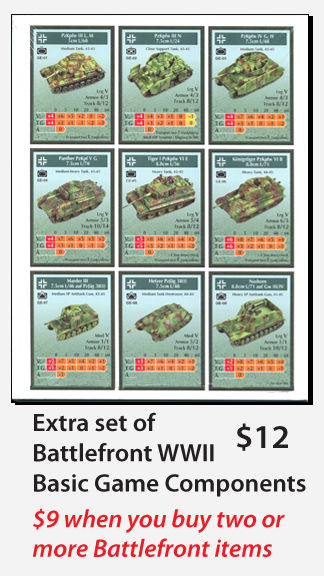
- 108 unit cards
- Artillery templates for scales from 5mm to 20mm
- 2 sets of tables & charts
- Game markers
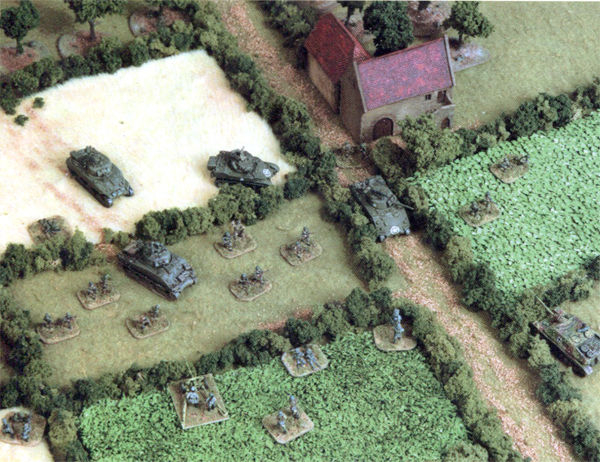
Battlefront WWII is a tactical level wargame of World War II ground combat using miniature soldiers and vehicles. The basic organization is the "maneuver element" which is usually a company sized formation of units which fight as a group. Each player takes command of one or more maneuver elements to refight either historical or hypothetical battles.
The Second World War was by far the largest military conflict in human history. Large-scale ground combat on three continents provides the miniature wargamer with a virtually limitless number of military actions to recreate, and more weapons and tactics than any other historical gaming period. Battlefront WWII allows players to explore the depth of this unique era by incorporating innovative game mechanics and intuitive graphic aids, enabling players to concentrate on the intricacies of combined arms tactics rather than the mechanics of the rules.
World War Two was the company commander's war, the front-line infantry or rifle company being the basic unit of tactical maneuver. The German and Soviet armies both discovered that the actual combat element almost invariably turned out to be 80-100 men. Anything larger and the company commander tended to lose control, anything smaller and casualties quickly made it ineffective. Grimly, the great majority of the casualties in all of the armies came from the men in these front-line infantry companies.
Battlefront WWII is designed to model this tactical level of combat. The basic organization used is the "maneuver element" which is usually a company sized formation of units which fight as a group. In Battlefront WWII each player takes command of one or more maneuver elements. A game involving several players may recreate tactical actions between opposing battalion or regimental sized forces and can be finished in a single evening.
- Each miniature or stand represents a squad of men, specialized team, or 2-3 vehicles or guns.
- Each game turn represents approximately 10 minutes of real time.
- The rules are designed so that each player can handle one or two maneuver elements (a maneuver element is roughly a company).
- Units of up to battalion size can be handled comfortably by experienced players.
- Although designed for 15mm miniatures, play aids and rules allow miniatures from 5mm (1/285) to 20mm to be used comfortably.
When we started playing armor miniatures games, we often found ourselves spending more time looking things up in the rulebooks than we did fighting the battle. Many rules present the player with reams of charts and tables, attempting to model every detail of combat. The player is supposed to command a battalion or larger formation at the same time deciding what kind of ammunition Pvt. Schultz loads into his rifle.
Battlefront WWII takes a different approach. By abstracting the detailed mechanics of combat, we allow the gamer to rapidly fight the battle and take the decisions that are appropriate for an overall commander. We assume that Pvt. Schultz was trained by his army to know what kind of ammunition to use, so that decision does not properly lie with his commander (the gamer). Forward observers are trained to call fire, tankers to drive tanks and shoot, infantry to advance by rushes, etc. How well they do this is influenced by the extent of their training and also their morale. The actual mechanics of doing these activities should not be the responsibility of the gamer.
 At the same time, one of the fascinating
aspects of World War II combat is the interaction between different types of units.
We balance the need for abstraction with the need for interesting detail by distilling
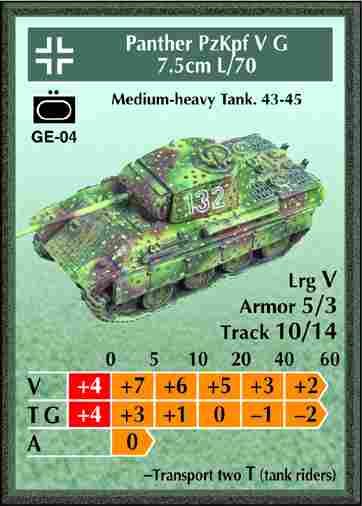
the different combat capabilities into "Unit Data Cards".
A separate unit card is provided for every type of vehicle, gun,
and infantry unit used in the game (for a full list of cards included in the basic game components, click here). To the right is a sample unit card for the German Panther Tank.
For an explanation of how the card works, click here. The cards not only provide
a concise game aid, but can also be used as a painting guide.
At the same time, one of the fascinating
aspects of World War II combat is the interaction between different types of units.
We balance the need for abstraction with the need for interesting detail by distilling
the different combat capabilities into "Unit Data Cards".
A separate unit card is provided for every type of vehicle, gun,
and infantry unit used in the game (for a full list of cards included in the basic game components, click here). To the right is a sample unit card for the German Panther Tank.
For an explanation of how the card works, click here. The cards not only provide
a concise game aid, but can also be used as a painting guide.
Abstract does not mean inaccurate. We did NOT ignore the details of combat and vehicle management,
range/penetration effects, artillery correction, rate of fire, and other details that occupy
the gamer's time in other rules. We spent a great deal of effort in getting the factors
on the cards correct and there are subtle differences in the capabilities of the units that are
caused by these details. For example, the US M-18 tank destroyer is slightly more
effective at anti-tank fire than other U.S. vehicles that use the same gun.
This difference is due to the U.S. Army's doctrine of giving these tank destroyer units more
of the effective anti-armor rounds than were given to the tanks. However,
this doctrine is outside of the gamer's control so it was incorporated into the unit card.
The charts and data cards allow the players to feel the effects of the details
without having to calculate them.
Decision Making
The result of the abstraction is that gamers must take their decisions
based on the general capabilities of their units instead of perfect knowledge.
Rather than basing a decision on the fact that a gun will penetrate "X mm of armor at range Y",
facts which were not known by the unit commanders at the time, the decision
will be based on the knowledge that "my tanks are more effective at long range"
or "I must close rapidly to be effective". We feel
that this type of decision more accurately models the decisions that are made by actual commanders. Also,
these decisions can be made much more rapidly than the conventional approach taken in tactical games. You
will spend your time playing the game instead of looking up values in charts.
Sequence of Play
Battlefront WWII is an "I go, you go" game. One side fires, moves, and completes its
actions, then the other side does the same. Each player turn consists of the following basic steps:
- Offensive Fire
- Maneuver
- Defensive Fire
- Close Combat
Combat
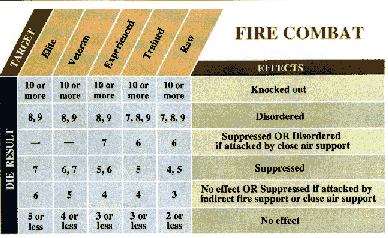 Combat is resolved by a simple differential system. The attacker's strength
is determined from based on weapon capabilities and modified by the type of attack, situation,
and a random die roll. The defender's strength is a function of armor and terrain. You
subtract the defender's strength from the attacker's strength to yield a differential
that shows how effective the attack can be. The effect of the attack will range
from "No effect" to "knocked out" with the majority of results being changes in
"order status" which effects morale and combat effectiveness. If they are not
destroyed outright, better quality troops are effected less by combat and this is reflected in the
combat results chart.
Combat is resolved by a simple differential system. The attacker's strength
is determined from based on weapon capabilities and modified by the type of attack, situation,
and a random die roll. The defender's strength is a function of armor and terrain. You
subtract the defender's strength from the attacker's strength to yield a differential
that shows how effective the attack can be. The effect of the attack will range
from "No effect" to "knocked out" with the majority of results being changes in
"order status" which effects morale and combat effectiveness. If they are not
destroyed outright, better quality troops are effected less by combat and this is reflected in the
combat results chart.
Since the same sequence is followed for direct fire, artillery, and aircraft attacks. Players
rapidly become acquainted with the mechanics of combat resolution and the capabilities of their
units and are able to quickly resolve combat.
Training and Morale
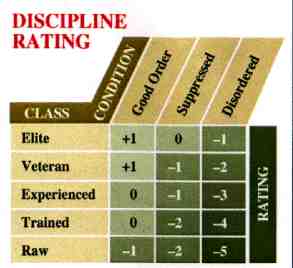 We did feel that training and morale are critical for an understanding of modern battles.
The Discipline Rating table modifies almost every action that can be taken. Units with superior training and morale will be much more effective
(+ is good, - is bad). The discipline rating table gives us a way of showing how good training and
high morale can sometimes be more important than equipment type.
We did feel that training and morale are critical for an understanding of modern battles.
The Discipline Rating table modifies almost every action that can be taken. Units with superior training and morale will be much more effective
(+ is good, - is bad). The discipline rating table gives us a way of showing how good training and
high morale can sometimes be more important than equipment type.
Every turn, each maneuver element must determine how well it will perform. All units
in the group are effected. At the beginning of the game, units will generally perform as
the player desires. As maneuver elements take casualties, they become less effective
and units in them may decide to stay put or even run away. Of course better quality units
are less likely to be effected than poor ones. This forces the player to consider keeping
a fresh company as a reserve, where it can sometimes turn the tide.
Artillery
 Artillery was the great killer in World War II. However, there were great differences
in how it was employed by the different nations. Even though all combat is resolved with the same differential mechanism, our artillery
rules manage to capture national differences in doctrine and effectiveness. Each side can
choose a variety of fire missions that reflect how their armies used their artillery. This will lead to various
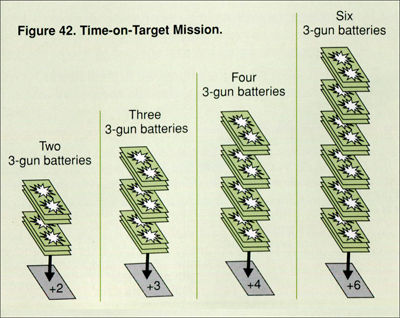
modifications of weapon strength. Perhaps the most effective example is the American's "Time on Target"
where they could concentrate several full batteries of artillery so that all the shells
land on the target in a short period of time. The diagram
to the right gives the basic idea. A multi-battery time-on-target mission can get the
attention of even the largest German Tanks.
Artillery was the great killer in World War II. However, there were great differences
in how it was employed by the different nations. Even though all combat is resolved with the same differential mechanism, our artillery
rules manage to capture national differences in doctrine and effectiveness. Each side can
choose a variety of fire missions that reflect how their armies used their artillery. This will lead to various
modifications of weapon strength. Perhaps the most effective example is the American's "Time on Target"
where they could concentrate several full batteries of artillery so that all the shells
land on the target in a short period of time. The diagram
to the right gives the basic idea. A multi-battery time-on-target mission can get the
attention of even the largest German Tanks.
Unit Organization
One of the strongest features of Battlefront WWII is its emphasis on proper force composition and
organization. In addition to specific orders of battle in our scenarios, we present large numbers of Tables
of Organization and Equipment (TOE) for the various forces represented in the rules. These are presented
in the context of the game, showing how maneuver elements are built from individual units and then how higher
echelon formations are built from maneuver elements. We show how additional attachments are made from
higher echelon formations to build a proper historically balanced force. For an example of this hierarchy, click here.